What is SEG and other FAQ
Silicone Edge Graphics (SEG) shows up in almost every retail, trade show, and event environment we work in. Most clients haven’t been told how the format actually works until they’re mid-project. These are the questions worth answering before that point


Frequently asked questions
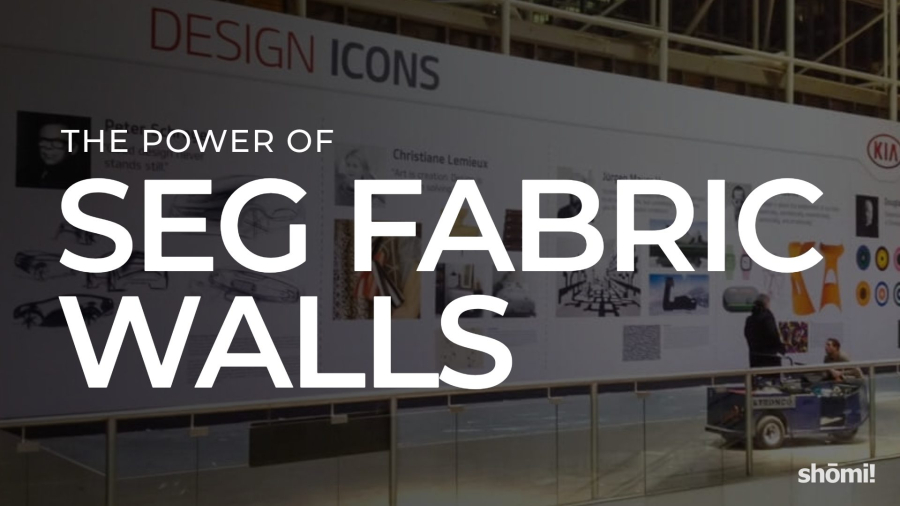
SEG stands for Silicone Edge Graphics. The display is a printed fabric panel with a thin silicone strip sewn along its edges. The strip presses into a matching groove in an aluminum frame, holding the fabric taut and edge to edge with no visible hardware.
Three things separate SEG from rigid signage and vinyl banners: the finish, the workflow, and the lifecycle. The silicone edge gives a flush, frameless look with no visible seams or hardware. Aluminum frames are lightweight enough for one-person assembly and dismantle. Graphics can be swapped without replacing the frame, which makes SEG more cost-effective across multiple campaigns or store rollouts.
Yes. The aluminum frame is the long-lived component, designed for repeated assembly cycles. The fabric graphic is washable and replaceable, so when the campaign changes the frame stays and only the graphic gets reprinted. This is the main reason SEG works well for retailers running seasonal or rotating displays.
Yes. SEG can be built wall-mounted, freestanding, suspended, curved, angled, or backlit, in custom sizes. The fabric flexes around shaped frames, which makes SEG one of the more adaptable display formats for non-rectangular or oversized environments.
The aluminum frame has a continuous channel running along its inside edge. To install, press the silicone strip on the fabric into that channel, working around the perimeter. The fabric pulls taut as it seats. No tools, no fasteners, no exposed hardware. Removing it is the same process in reverse.
Standard SEG is designed for indoor use. Outdoor-rated SEG exists and uses different fabric, ink, and frame materials engineered for UV, moisture, and wind exposure. If the install is outdoor, this needs to be specified at the design phase, not adapted afterward.
Dye-sublimation. The ink is heat-transferred into the fabric fibres rather than sitting on top of the surface, which is why SEG graphics resist fading and do not crack or peel with handling. The trade-off is that colour matching is slightly different from standard offset or inkjet printing, so brand colours should be approved on a fabric proof rather than a paper proof.
Very. Aluminum frame components are lightweight, and SEG fabric folds without permanently creasing, so a frame and its graphic typically ship in a soft case or compact crate. Most SEG displays are set up by one or two people without specialized tools.
Yes. Backlit SEG uses an LED-edge or LED-array lightbox frame in place of a standard SEG frame. Light passes evenly through the fabric, creating a glowing display with no visible bulbs or hot spots. This is the format used in retail, transit, and trade show environments where the display needs to read at distance or in low light.
No. LEDs draw substantially less power than fluorescent or incandescent lighting at equivalent brightness output. Exact wattage depends on the size of the box and the LED array configuration, but for retailers running illuminated displays many hours per day, a backlit SEG lightbox is generally one of the lower-power options available among illuminated display formats.
When the message changes more than once a year, when the install needs to ship and reinstall multiple times, or when the environment calls for a frameless, oversized, or backlit look. Rigid signage still wins on permanent installations where the graphic never changes and weight is not a concern.
The aluminum frame is built for years of repeated use. The fabric graphic itself depends on handling, washing frequency, and lighting conditions, but a properly stored SEG graphic typically lasts through multiple campaign cycles before colour or surface degradation becomes visible.
Yes. SEG is used across retail stores, pop-ups, and mall installations, trade shows and exhibitions, corporate environments, museums, conferences, and event spaces. The format works in any environment where a clean, frameless graphic surface is needed and the install conditions are predictable. The fabric weight, frame depth, and lighting configuration may change between use cases, but the underlying SEG system is the same.
Do you still have questions? We’d be happy to answer them. Email us at [email protected] for more information.