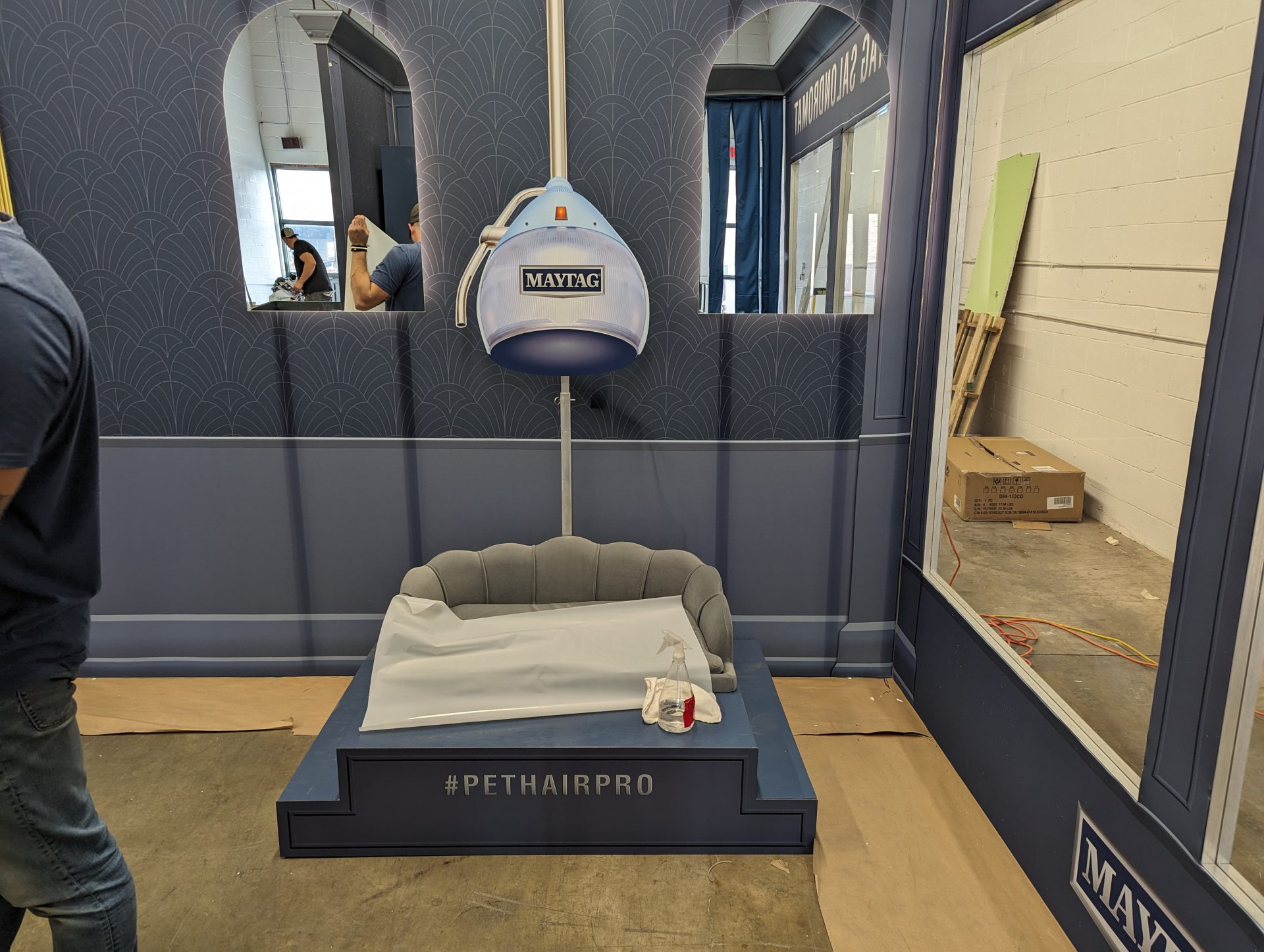
Two dogs sit on a bench under a vintage hair dryer in a salon. Text reads “Maytag Salondromat Case Study” on a blue background, highlighting the Maytag Case Study with the shomi! logo in the bottom right corner.

Maytag Case Study

How do you build one photo op that works for a chihuahua and a great dane?
Project at a glance

Client: Maytag
Agency: prspktvMEDIA
Event: Canadian Pet Expo
Footprint: 10′ x 20′ trade show booth

Objective: Launch a pet-focused washer and dryer, engineered to remove five times more pet hair than other models, in a playful, premium environment built around that claim

When Maytag launched a pet-focused washer and dryer at the Canadian Pet Expo, the booth had to land as a high-end pet salon, ship clean to a second city, and stay inside a real-world trade show budget. Here’s how shōmi! built it.

The brief: a luxury pet salon that ships flat

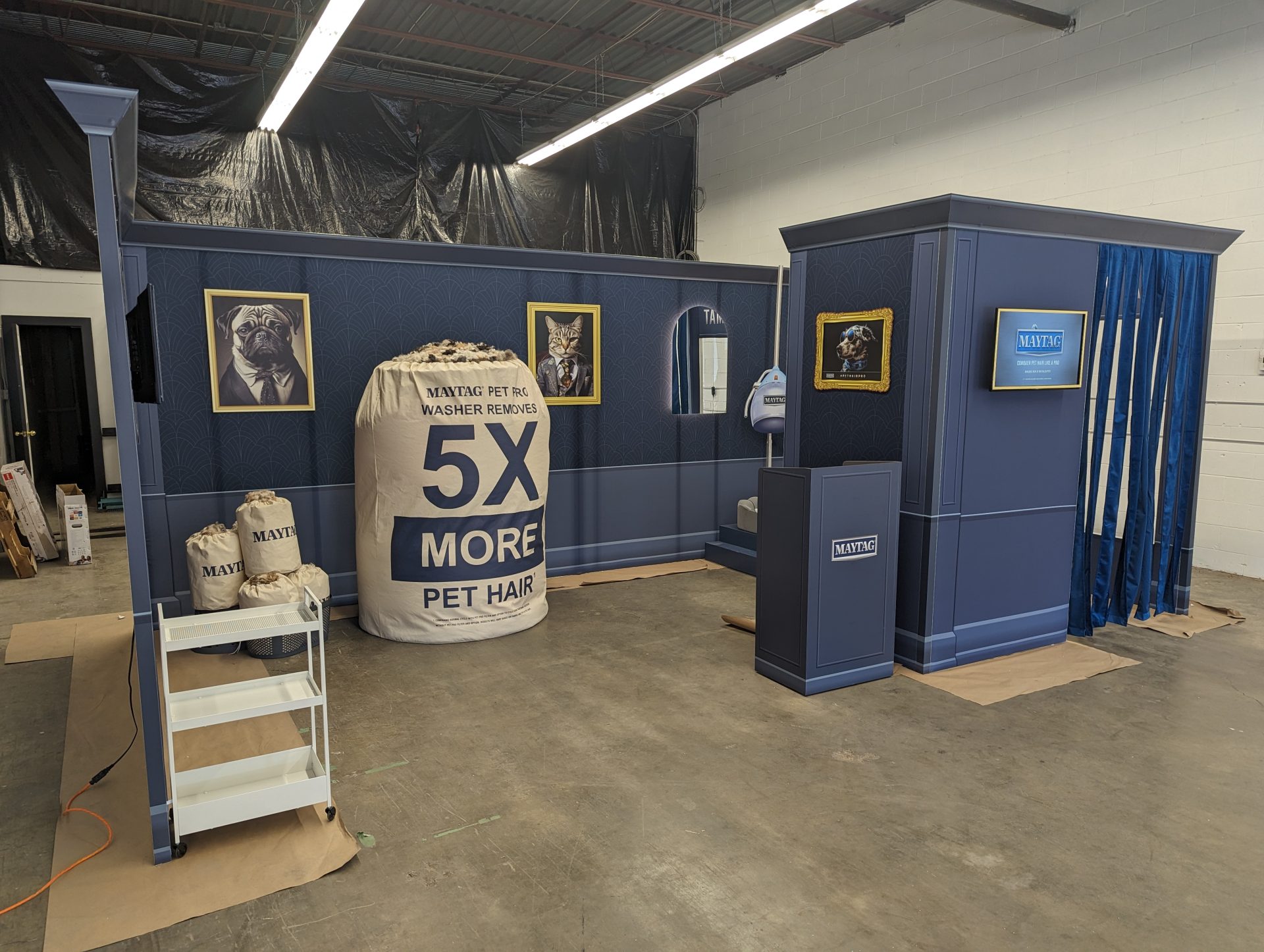
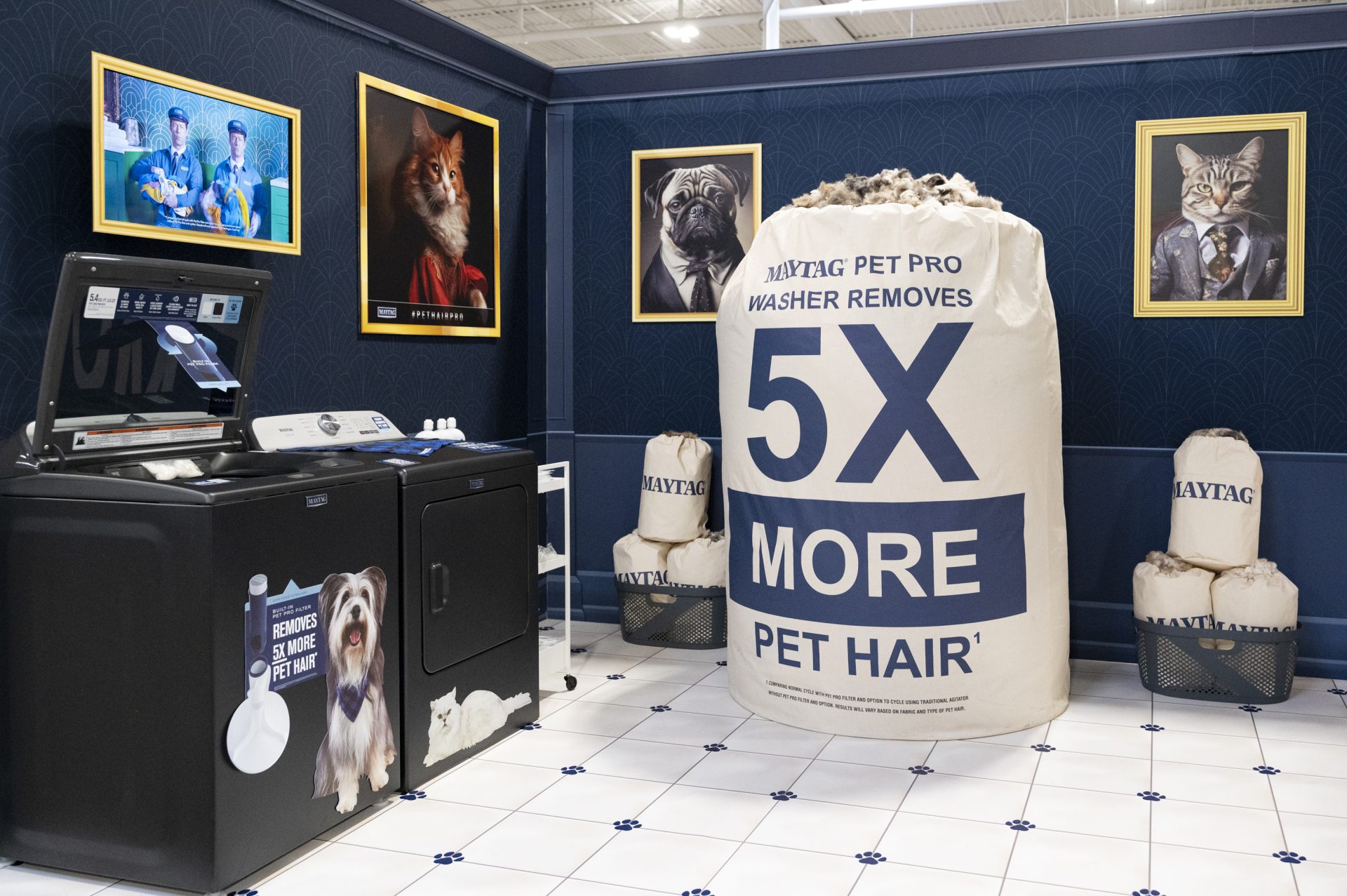
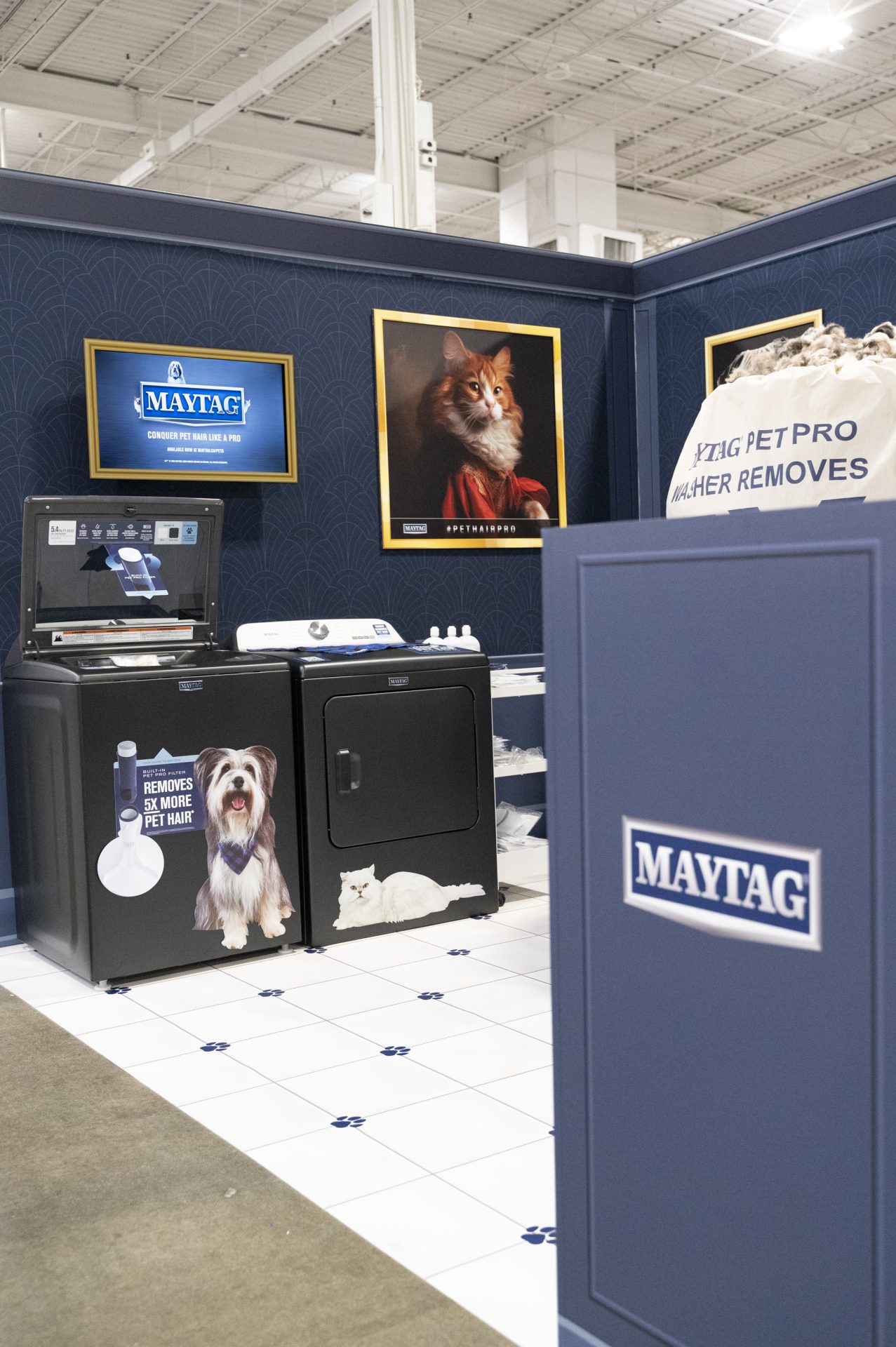
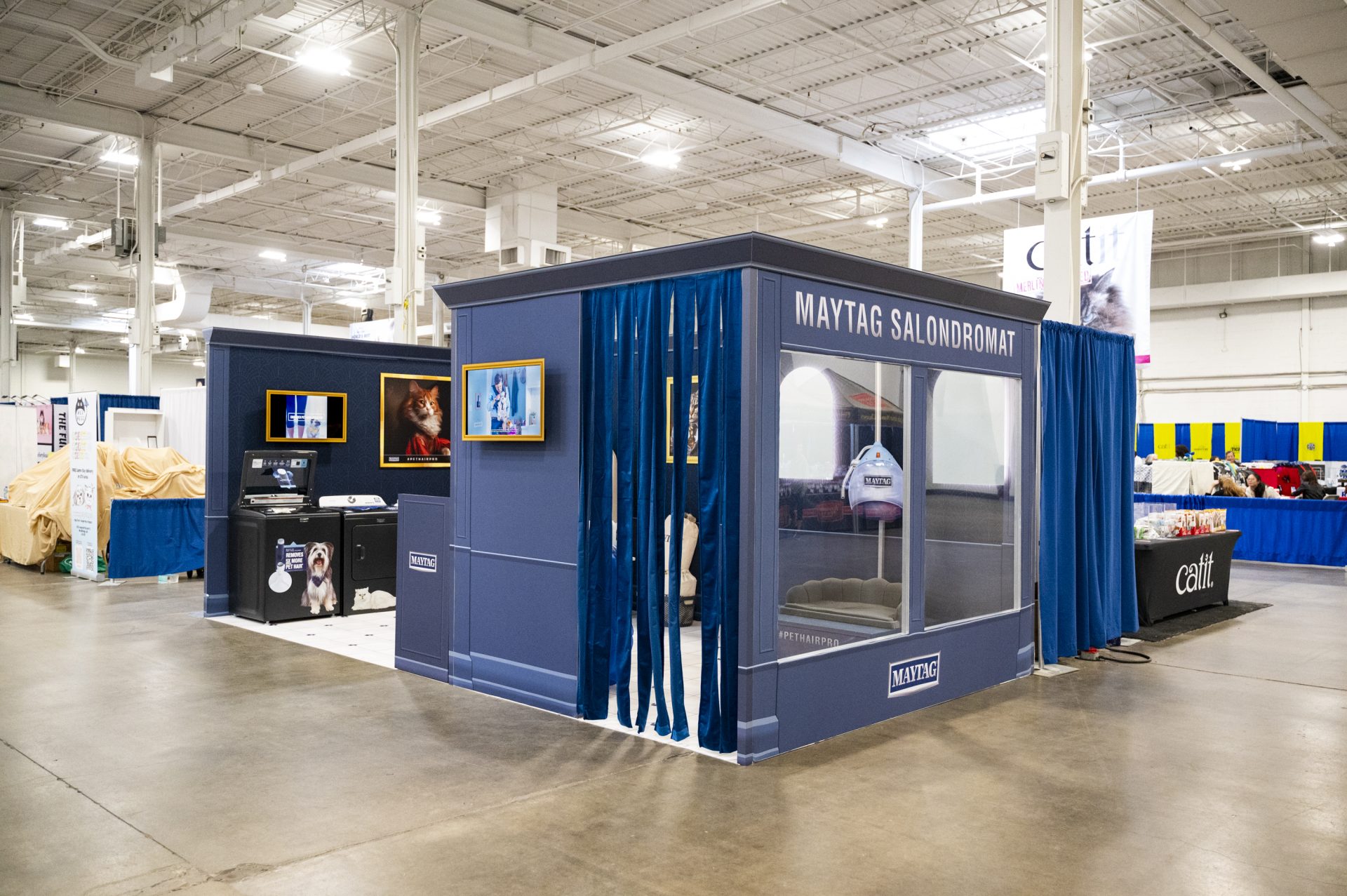
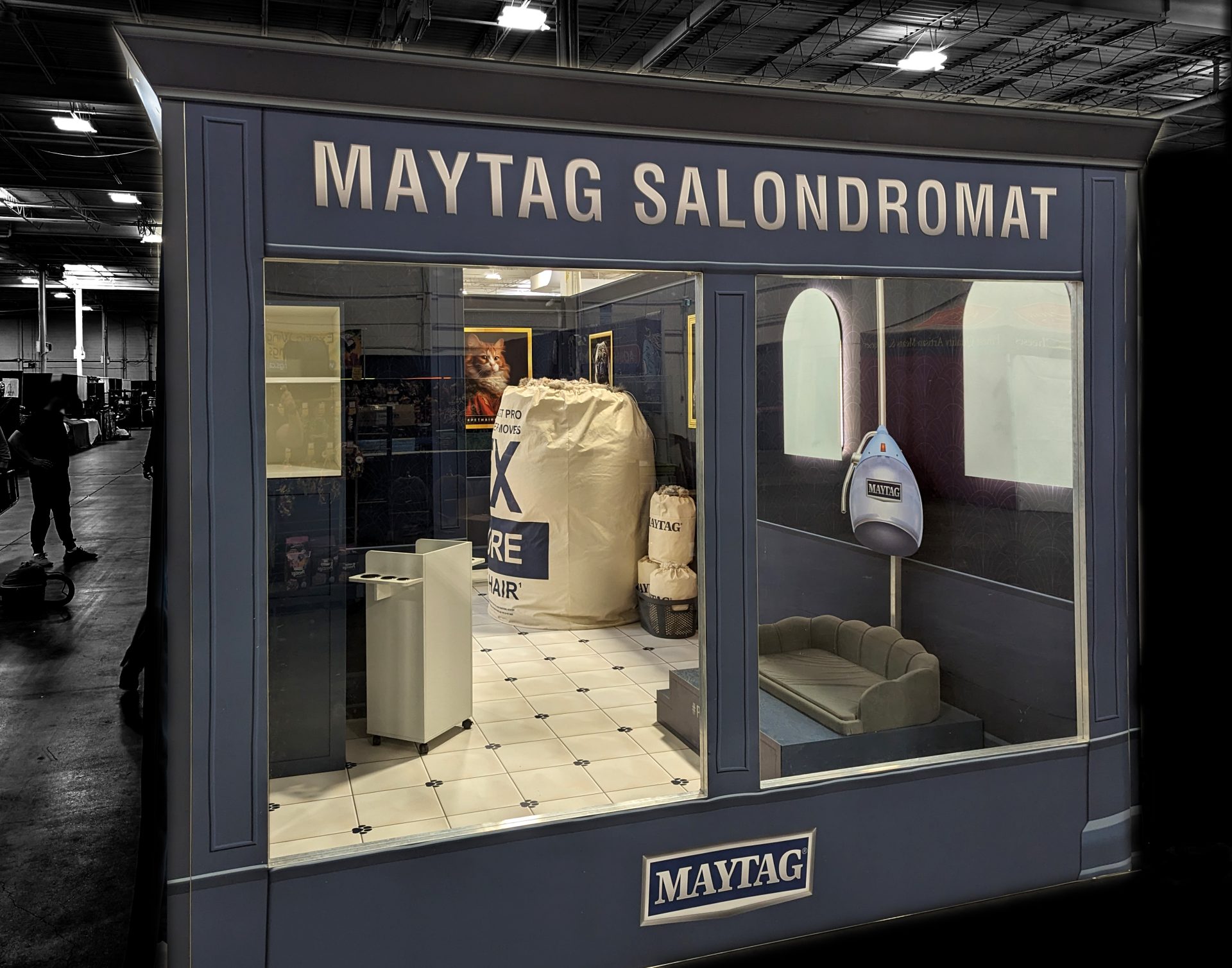
prspktvMEDIA came to shōmi! with a clear creative concept: a “Salondromat,” a tongue-in-cheek pet salon environment with crown molding, wainscoting, framed pet portraits, and a salon-style hairdryer photo op. The challenge wasn’t the concept. It was the reality of a 10×20 booth, a fixed budget, and a second-city deployment that ruled out anything heavy, fragile, or one-time-use.

Every element had to do three jobs at once: look premium on the show floor, ship in a manageable footprint, and set up fast.

Faking the architecture

The walls did the heavy lifting on the “luxury salon” read, but real wainscoting and crown molding were off the table. They blow trade show budgets, break in transit, and add days to install.

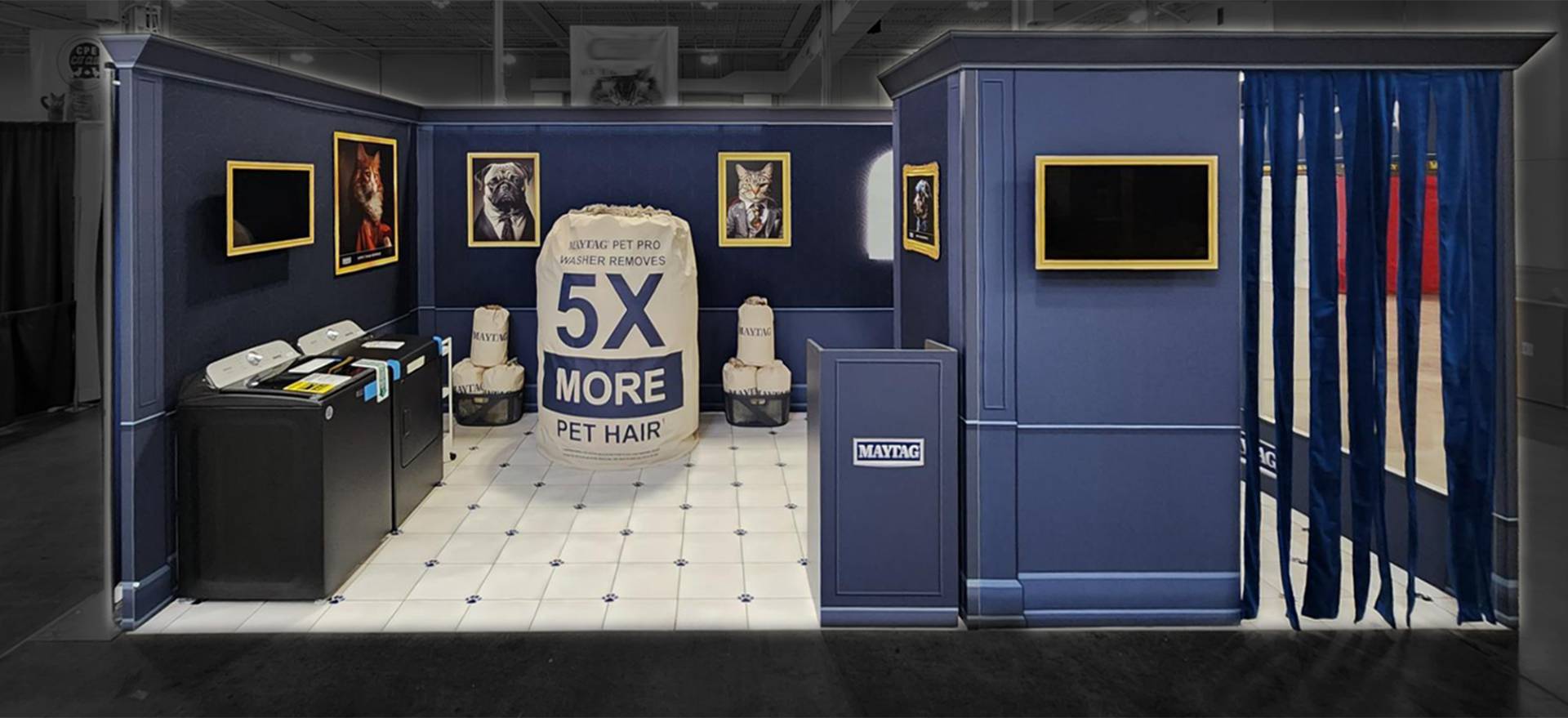
The solution was a two-layer approach. SEG stretch fabric panels were printed to simulate wainscoting and upscale paneling, giving the walls the depth and tone of a renovated salon at a fraction of the weight. The faux crown molding was achieved with printed pressure-sensitive vinyl applied to aluminum composite, delivering the architectural detail at a fraction of the cost. From the aisle, the walls read as a real space. From the crate, they read as flat panels.

The framed pet portraits used the same logic. Rather than building or sourcing actual frames, frame graphics were printed directly onto flat stock alongside the portrait images, giving the gallery-wall effect without the weight or breakage risk.

Solving the floor in a tube

A tile floor with embedded paw prints would have looked the part and added two days to install, plus a hard-to-ship footprint. The shōmi! graphic designer created a custom tile-and-paw-print pattern in-house and printed it on roll-up flooring. The visual story was identical to laid tile. Setup took minutes. The whole floor shipped in a tube.

The hair bags

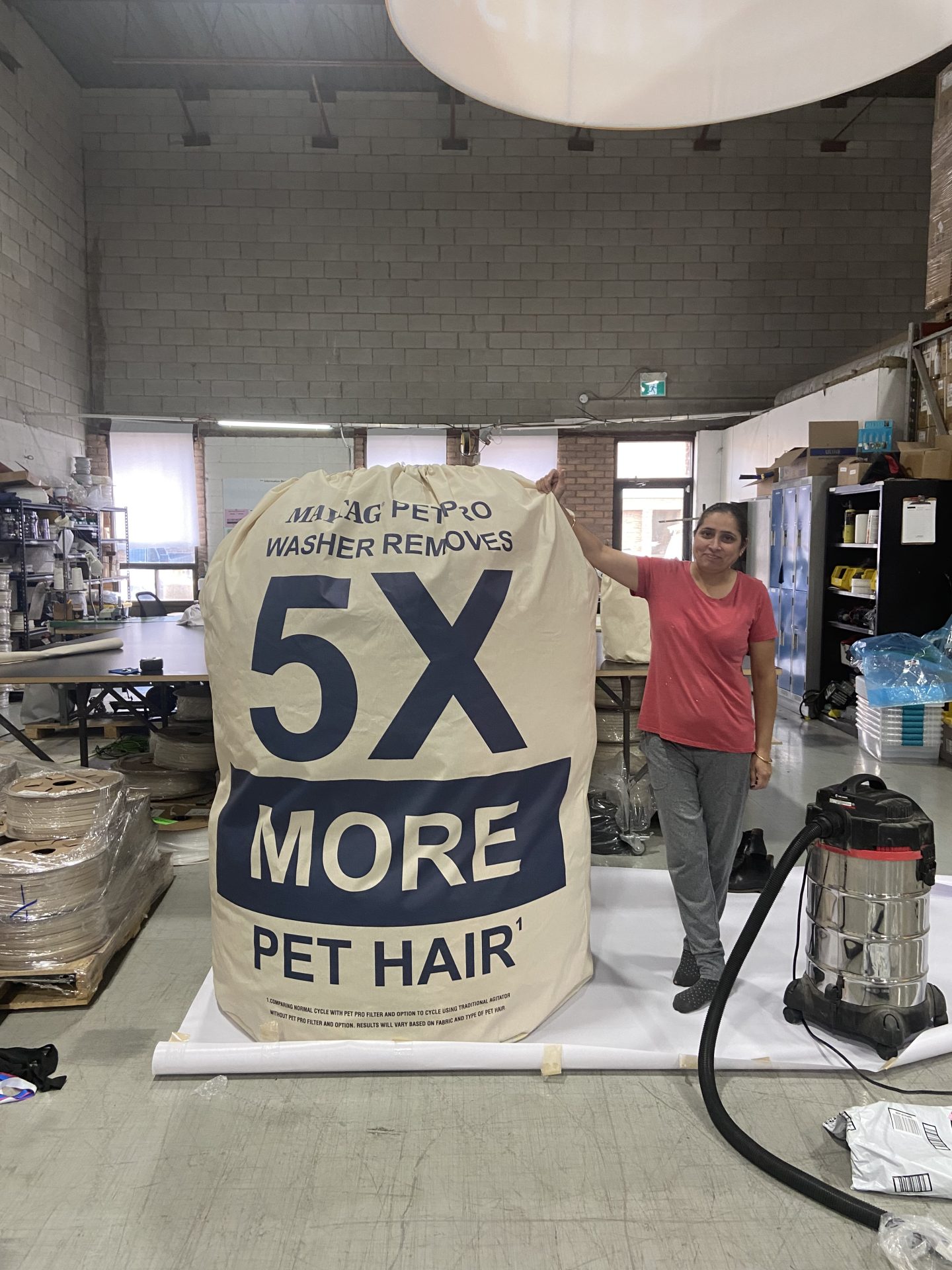
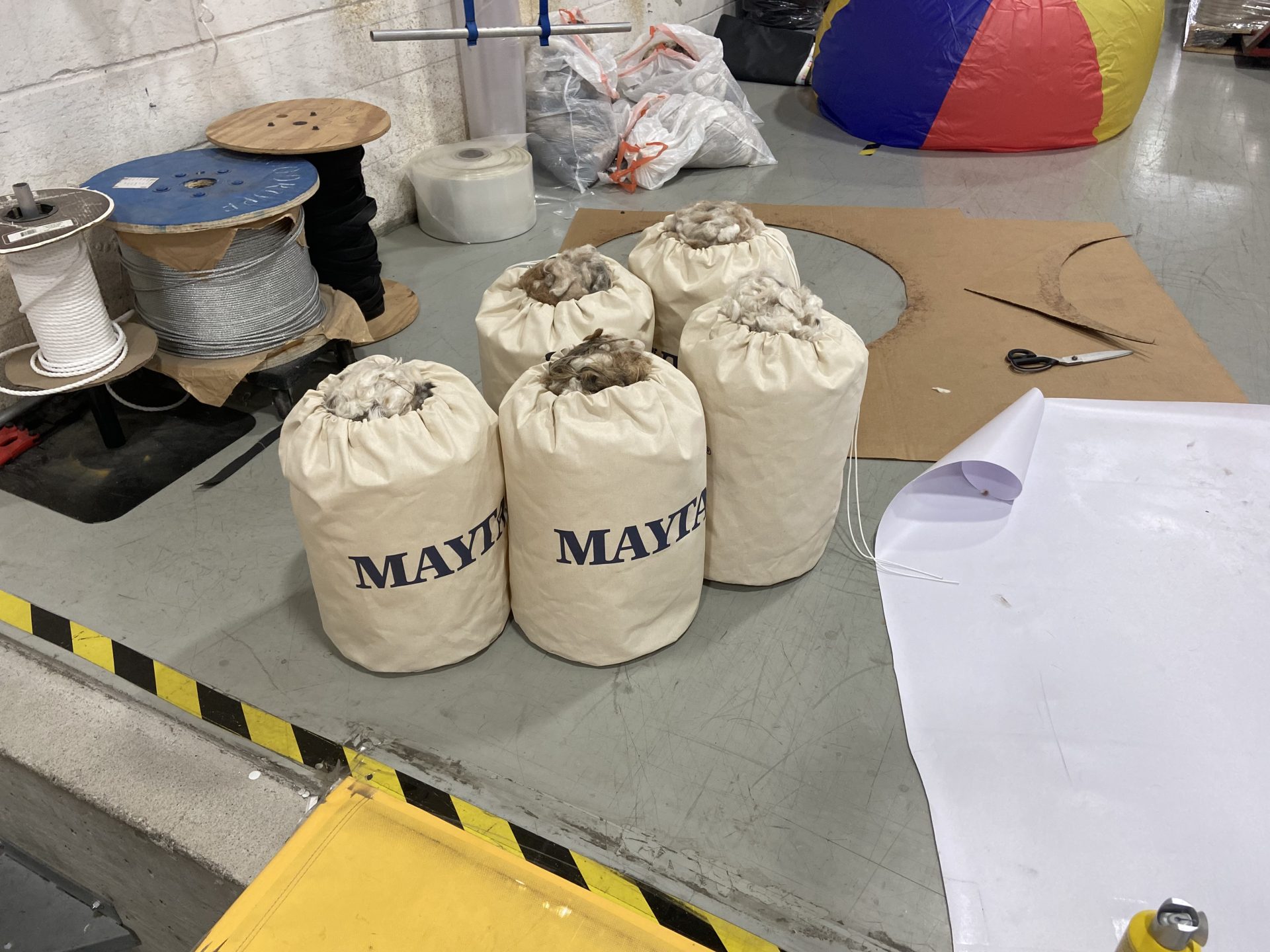
The hero prop of the booth was a pile of oversized pet hair bags sitting beside the washer and dryer, making Maytag’s claim, removing five times more pet hair than other models, impossible to miss. Filling them with real pet hair alone would have made them heavy and slow to ship between cities. Filling them with fake material would have lost the realism the concept depended on.

The shōmi! solution mixed real pet hair with bubble wrap for volume, giving the bags the right read at conversational distance without the weight. The largest hero bag was built around an inflatable core, allowing it to ship flat and inflate to full visual scale on site.

The hairdryer photo op

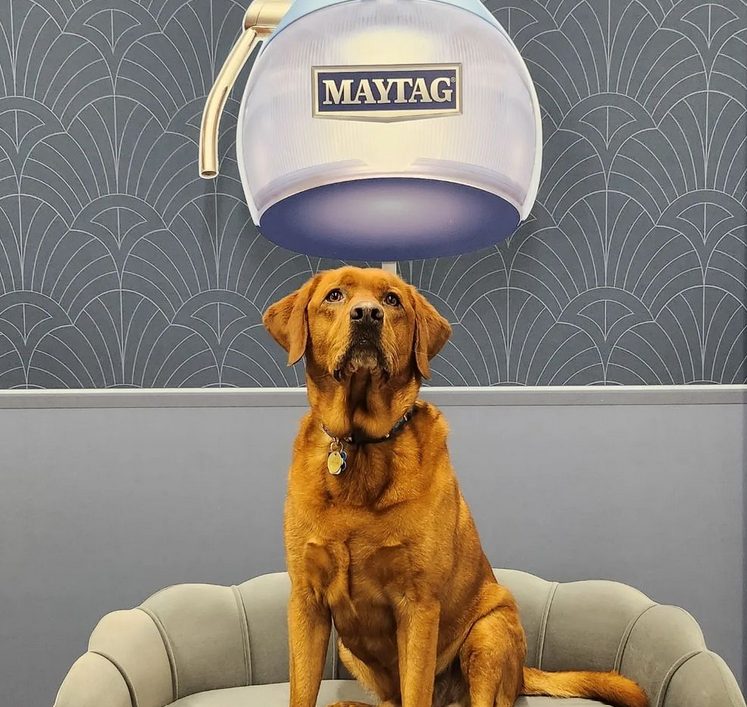
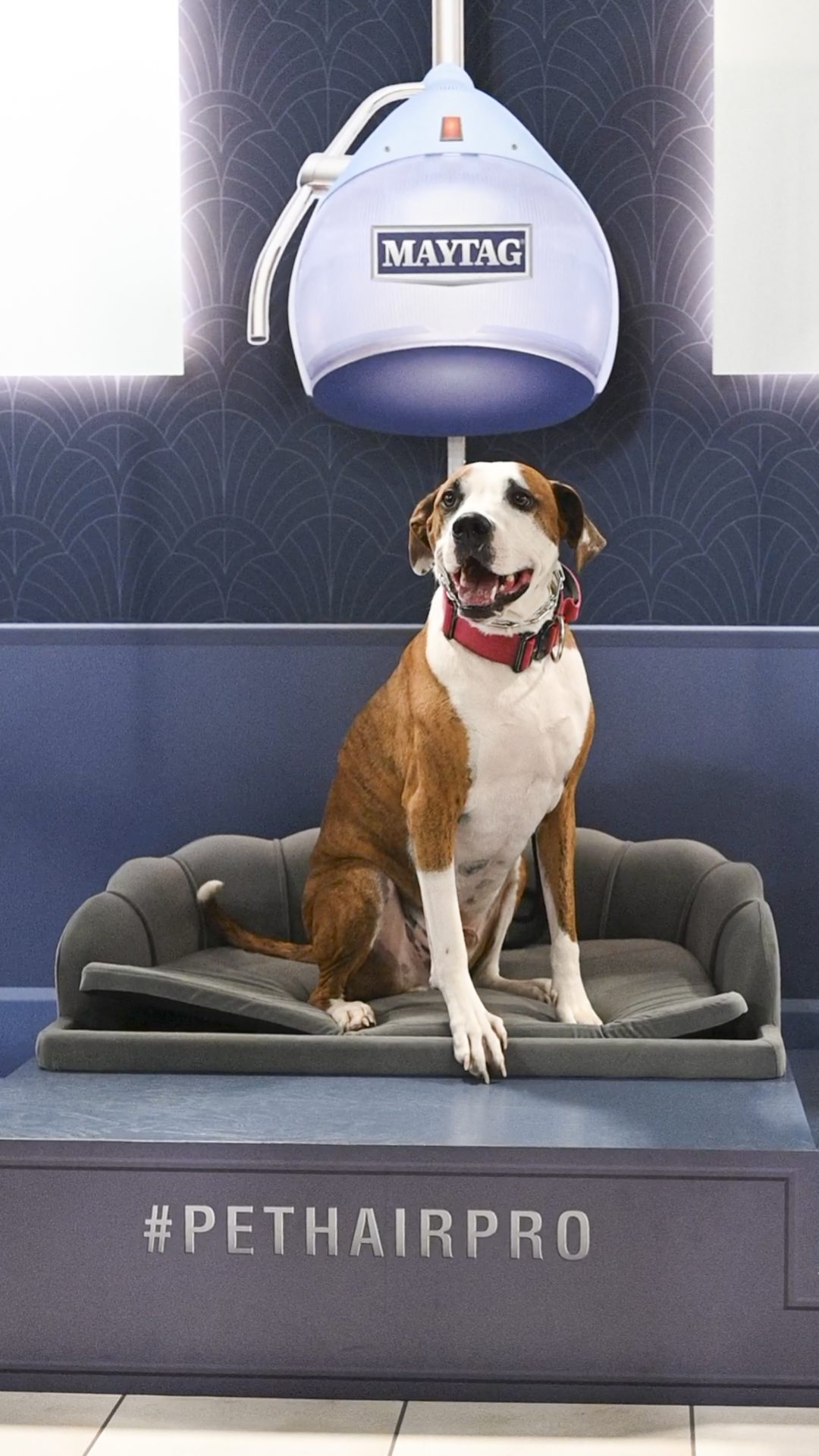
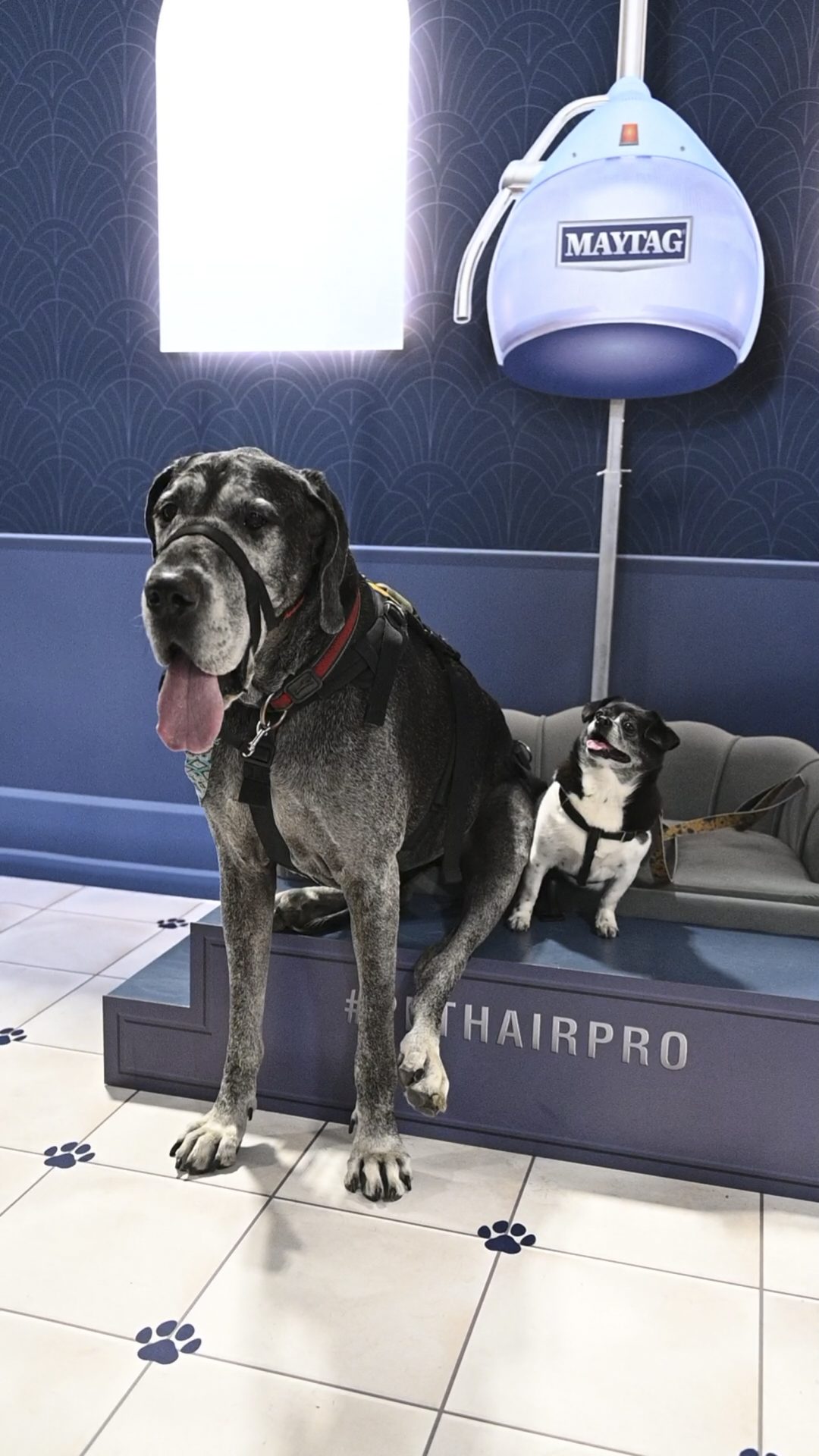
The salon-style hairdryer was the booth’s signature interactive moment, designed to draw attendees and their pets into a shareable photo. Because the booth had to work for a chihuahua and a labradoodle in the same hour, the hairdryer needed a height-adjustable frame that booth staff could operate quickly between takes.

The result was a working photo op rather than a decorative prop, which is how it generated the line, the social tags, and the conversations Maytag came to the show to start.

What this kind of build proves

Builds like this one come down to judgment about where to spend the money and where to fake it convincingly. Real architecture and tile would have eaten the budget and blown the timeline. Pure-fur hair bags would have been too heavy to ship and too bulky to move between cities. The decisions that made the Salondromat work weren’t about doing less. They were about knowing which details people actually remember.

For Maytag and prspktvMEDIA, that meant a booth that delivered a premium brand experience, travelled to a second city without rebuilding, and gave the Canadian Pet Expo a memorable corner of the floor.

Planning a similar build?

If you’re working on a trade show booth, retail install, or experiential build that needs to land as premium without the premium budget, we’re happy to talk through what’s possible and where the smart spends usually go.

Frequently asked questions

How can a trade show booth feel premium without a premium budget?

By choosing carefully where to spend and where to simulate. Real architectural detail (crown molding, laid tile, hardwood, lacquered finishes) usually breaks the budget and the timeline. The Maytag Salondromat booth achieved a high-end pet salon aesthetic by simulating the architecture: printed vinyl on aluminum composite for crown molding, SEG fabric for wainscoting, roll-up printed flooring for tile. The budget went to the moments people actually remembered, including the oversized hair bags and the height-adjustable salon hairdryer photo op. The judgment call is which details earn their cost.

Can a custom trade show booth ship to multiple cities without rebuilding?

Yes, if it’s engineered for travel from the start. The Maytag Salondromat booth was built for the Canadian Pet Expo and then a second city, which meant every component had to ship in a manageable footprint, set up fast, and survive a second handling without being remade. Achieving that meant flat-packing the walls as SEG fabric panels, rolling up the printed floor into a tube, and engineering the hero hair bag around an inflatable core that shipped flat and inflated on site.

What is SEG fabric and why is it used in trade show booths?

SEG fabric is silicone edge graphic fabric: a printed stretch fabric panel with a thin silicone bead sewn around its edge that locks into a recessed channel in an aluminum frame. It’s used in trade show booths because the graphics swap out easily, the panels ship flat, and the finished surface is tight, seamless, and dust-free. In the Maytag Salondromat booth, SEG fabric was printed to simulate wainscoting and upscale wall paneling, delivering the depth of a renovated room at a fraction of the weight.

How do you fake crown molding in a trade show booth?

With printed pressure-sensitive vinyl applied to aluminum composite. In the Maytag Salondromat build, this approach delivered the architectural detail of crown molding without the cost, weight, or fragility of the real thing. The vinyl carries the printed molding profile and shadow, and the rigid aluminum composite substrate gives the wall a clean, finished read from the aisle. It ships flat and survives transit.

Can printed flooring replace real tile in a trade show booth?

Yes, and for trade show and modular deployments it usually should. Laid tile is heavy, takes hours to install, and is hard to ship between cities. Roll-up printed flooring delivers the same visual story (in the Maytag Salondromat case, a custom tile and paw print pattern designed in-house), rolls into a tube for transport, and sets up in minutes. For shows with tight install windows or multi-city tours, printed flooring almost always wins on cost, install time, and reusability.

How do you build a 3D trade show prop that ships flat?

Engineer it around an inflatable core or collapsible armature, and use lightweight fill materials to add volume. The Maytag Salondromat’s hero pet hair bag had to read as a full sack of hair from across the aisle while shipping in a manageable footprint. The shōmi! solution was an inflatable membrane inside the bag plus a fill of real pet hair mixed with bubble wrap. The bubble wrap added volume without adding weight, and the inflatable core let the prop ship flat and reach full visual scale on site.

We’ve faked crown molding, shipped inflatable hair bags, and built a hairdryer for every size of dog. Whatever’s got you stuck, we’ve probably faked something weirder. Tell us about it.

Bright orange background with bold text: “Why Animated Lightboxes Outperform Static Displays.” Two SEG Lightboxes feature a vivid beach scene and a grayscale beach with a sad face. Shomi! logo sits at the top left, highlighting animated lightboxes.

Why Animated Lightboxes Outperform Static Displays

Static Displays Blend in. 
Animated Lightboxes Don’t.

Let’s be honest about the state of physical environments.

Retail floors are crowded. Trade shows are louder than ever. Experiential spaces are designed to overwhelm. In that context, most static displays aren’t competing, they’re blending in.

That doesn’t mean static is “bad.” It means the environment has changed.

And the brands that haven’t adjusted are paying for square footage that no one truly sees.

Motion Is No Longer a Gimmick.
It’s a Baseline Advantage.

There was a time when animation in physical displays felt like a novelty. Flashy. Overused. Easy to get wrong.

That era is over.

Today, the most effective animated lightboxes aren’t trying to impress. They’re doing something far more valuable: interrupting visual autopilot.

Subtle fades. Gentle sequencing. Controlled highlights.

Nothing loud. Nothing desperate.

Just enough motion to make the eye stop pretending it didn’t see the display.

Static Relies on Permission.
Motion Takes It.

A static display waits for someone to choose it.

Animated lightboxes don’t.

They earn attention passively, without demanding interaction, sound, or screens. In high-traffic environments where no one is browsing casually, that distinction is everything.

If your display needs a viewer’s goodwill to work, it’s already losing.

Premium Brands Can’t Afford to Look Static

For premium brands, this isn’t about “standing out.” It’s about signaling relevance and investment.

Animation, when done properly, communicates:

  • Intentional design
  • Considered execution
  • Confidence in restraint


It doesn’t scream innovation. It suggests control.

And control is what premium brands are actually selling.

Why Screens Aren’t the Answer

This is where many teams over-correct.

Screens solve attention problems by dominating the space. Animated lightboxes solve them by integrating into it.

They maintain materiality. They respect architecture. They don’t turn physical environments into digital billboards.

In many cases, animated lightboxes do the job brands want screens to do but without the downsides.

More Brands Should Be Using Fewer Displays, With More Thought

Here’s the uncomfortable truth:

If everything is static, nothing is special. If one element moves, it becomes the anchor.

Animated lightboxes allow brands to design hierarchy back into environments that have lost it. They help teams say more by showing less, over time.

That’s not a creative trend. That’s communication fundamentals catching up with reality.

Good Execution Is the Entire Ball Game

Animated lightboxes only work when the build is solid.

Motion adds pressure behind the scenes; power, durability, installation, and long-term reliability. If those details aren’t solved early, animation doesn’t elevate the display. It exposes its weaknesses.

That’s why animation can’t be an afterthought. When it’s planned from the start, motion feels effortless and premium. When it’s added late, it becomes fragile.

The best animated displays don’t come from bigger ideas. They come from execution that’s been thought through before anything is built.

The Bottom Line

Static displays still exist because they’re easy and useful in the right circumstances.

Animated lightboxes are winning because they’re intentional.

They don’t try to out-shout the environment. They out-think it.

And in today’s physical spaces, the brands that win attention aren’t the loudest ones.

They’re the ones that don’t wait for attention; they interrupt it!

Tradeshow Design(1)

Acquiring and Using Sustainable Materials in Trade Show Design

Most trade show builds aren’t built to last. Single-use materials, oversized crates, energy-hungry setups, and a dumpster waiting in the parking lot when it’s all done. It’s the industry default, and it’s getting harder to defend with a straight face.

The good news: sustainable trade show design has caught up. The materials look as good as the conventional ones, install as cleanly, and ship lighter. Here’s how to source and use them without compromising on what the booth actually needs to do.

What “sustainable material” actually means

Sustainable materials are renewable, recyclable, biodegradable, or made from recycled content. When you’re evaluating options for a trade show build, the useful questions are:

  • Recyclability and reusability. Can this material live another life after the event, or is it heading straight to landfill?
  • Biodegradability. If it does end up in waste, does it decompose, or is it still around when your grandkids are explaining what trade shows were?
  • Sustainable sourcing. Where did it come from, and can the supplier prove it?
  • Energy efficiency. What’s the embodied energy in production, and what’s the energy load during the booth’s run?

Sourcing the right materials

Sourcing sustainably isn’t about slapping an “eco” sticker on whatever you were going to use anyway and calling it a day. Three things to look for.

1. Work with vendors who can back up the claim

Some vendors are genuinely sustainable. Others have a marketing department and a green colour palette. The difference shows up in their certifications. Look for:

  • FSC (Forest Stewardship Council) for wood and paper products from responsibly managed forests.
  • Cradle to Cradle for materials designed to be reclaimed and reused at end-of-life.
  • GREENGUARD for low chemical emissions, especially relevant for indoor environments.

2. Recycled and upcycled materials

Recycled aluminum, reclaimed wood, and upcycled fabrics deliver the same finish as new materials with a fraction of the environmental cost. For booth fixtures and structural elements, recycled aluminum extrusions are the workhorse: strong, light, and infinitely recyclable, which is more than you can say for most things on a trade show floor.

3. Modular and lightweight systems

Modular displays built from aluminum frame systems and tensioned fabric (SEG) pack down efficiently, ship light, and reconfigure for different shows. Lower shipping emissions, lower freight bills, less waste at end-of-program. FABRiK Frames are a useful example: the aluminum frames are reusable across years, and the fabric graphics swap out cleanly when the messaging changes.

Designing for longevity, not just one show

A booth designed for a single use is the most expensive booth you can build, environmentally and financially. The smarter approach is to design for reconfiguration from the start.

1. Build for multiple activations

Modular systems that scale up and down, swap out graphics, and reconfigure for different footprints earn back their investment across two or three shows. Aluminum extrusion plus tensioned fabric is the most flexible system for this, and it’s why the same backwall can quietly do five years of duty under three different campaign skins.

2. Use energy-efficient lighting

LED lighting has become the default for backlit displays and accent lighting, and for good reason: dramatically lower energy use than fluorescents or halogens, longer lifespan, less heat. Most iMPAKT lightboxes use LED strips that draw a fraction of the power of older lit displays. The booth doesn’t double as a space heater, which event planners and HVAC systems both appreciate.

3. Reduce waste with smart logistics

  • Stackable, compact designs. Fewer trucks, less fuel, less freight cost.
  • Return and reuse programs. Components that get a second life instead of a dumpster.
  • Local sourcing where possible. Shorter supply chains, lower shipping emissions, easier reorders.

4. Talk about it

If you’ve made sustainable choices, tell the visitors who care. A small panel on the booth, a QR code linking to a sourcing breakdown, or a line in the booth signage costs almost nothing and adds real credibility for the audience that’s looking for it. Just resist the urge to put “eco-friendly” on a vinyl banner.

The business case, briefly

Sustainable trade show design isn’t just good for the planet. It’s good for the build budget over time, it shortens freight bills, it future-proofs the program against tightening regulations, and it gives the brand something honest to talk about on the booth floor.

At shōmi!, we’d rather build a display once and use it for three years than build it three times in a row. If you’re planning a trade show program and want to think through what a longer-life, lower-waste build could look like, we’re happy to take a look.