
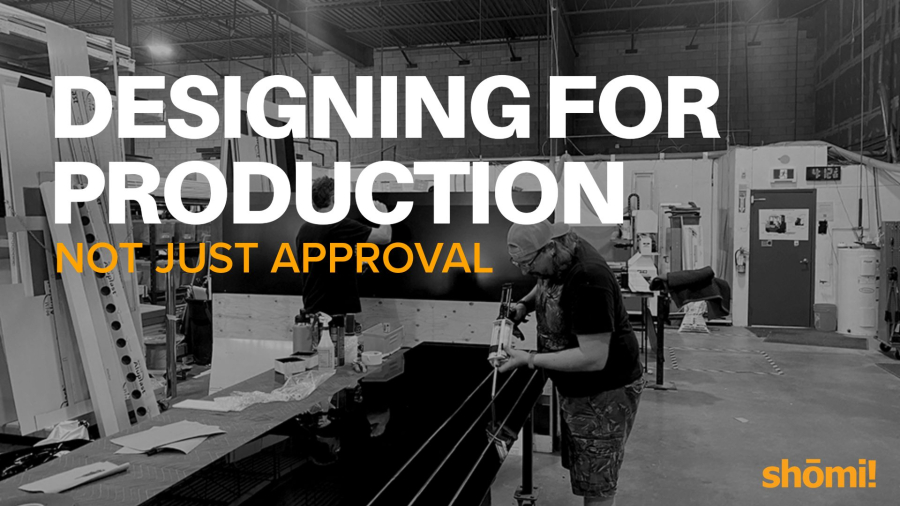
How to prevent beautiful ideas from becoming expensive problems
Most project problems aren’t design problems. They’re sequencing problems. When production thinking enters a project after approval instead of before it, the cost of every mistake multiplies. This article covers the most common disconnects, what regulations catch teams off guard, and what a real before-and-after looks like when production is brought in too late.
The moment things start to unravel
The client signs off. Everyone’s relieved. The file gets sent to production.
Then the questions start arriving. Can this actually be fabricated at that dimension? Who owns the structural connection detail? What does the mall criteria package require? Will this clear fire egress?The concept was strong. The approval was real. But the design was built for a screen, not a shop floor, and now the gap between the two is being paid for in rework, delays, and margin. This isn’t a failure of creativity. It’s a failure of sequencing. And it’s one of the most preventable problems in branded environments work.
Why beautiful concepts break down in production
Design and production aren’t in conflict by nature. But they operate on different assumptions, and when those assumptions don’t get reconciled early, someone pays for the gap later. A designer working in a presentation environment is optimizing for communication: making an idea legible, compelling, and approve-able. That’s exactly the right instinct for that stage. The problem is when the file moves to fabrication without ever being stress-tested against the physical world.
These aren’t gaps in the anyone’s skills, they’re gaps in process and communication.
The most common disconnects show up in a predictable cluster:
- Graphics can be printed perfectly and still fail at install. Silicone beading is structural. If the bead isn’t inserted at consistent depth and uniform tension, edges creep out of the frame, corners pull loose, and surface tension goes uneven. It’s not a problem you see in the proof — it’s a problem you see after the display has been up for a week, or after the first time it’s removed
- Materials called out without confirming availability at the run quantity or lead time the project requires
- Dimensional elements designed without any structural logic, leaving engineering to reverse-engineer the intent
- Tolerances ignored entirely, because on a screen, everything fits
Tolerances: why a few millimetres can cost a full reprint
When a sign is designed, a few millimetres of deviation is invisible. When that sign is fabricated and standing next to the one beside it in a row, those millimetres are the difference between a clean system and one that looks like it came from different projects.
Tolerances aren’t a production afterthought. They’re a design input, and production’s job to provide them early enough to matter.
In SEG fabric displays, this becomes especially precise. The silicone edge has to fit the extrusion channel correctly. If the fabric is printed or cut outside of the tolerance range, the tension is wrong, the surface ripples or sags, and the visual integrity of the display collapses. A few millimetres, in the wrong place, costs a reprint across the full run.
The broader issue is that tolerances establish the relationship between design intent and production reality.
When that relationship isn’t defined in the design file, it gets defined by whoever’s standing at the machine. That’s not where you want that decision made.
Structural realities most designers never see
A rendering looks solid. It’s holding itself up, it’s casting the right shadows, the proportions feel right. What the rendering doesn’t show is what’s actually keeping it there.
Structural questions that have to be answered before fabrication:
- How is the display anchored, and to what?
- What’s the load rating of the ceiling or floor at the install location?
- If it’s a hanging element, what are the rigging requirements and who certifies them?
- If it’s freestanding, does it meet tip-over standards?
- If it’s a counter or kiosk, does the substrate support the hardware being mounted to it?
These aren’t obscure questions. They’re questions that will be answered before the project ships regardless.
The only variable is whether they’re answered during design, when changes are cheap, or during fabrication, when they’re not. Branded environments are physical infrastructure. They have to behave like it.
The regulations that catch teams off guard
Three categories of regulation create the most friction when they’re discovered late.
ADA and provincial accessibility standards
Mounting heights, projection distances from circulation paths, character sizing, contrast ratios, these parameters govern a range of display and signage attributes. In Canada, provincial accessibility legislation adds requirements that don’t always align with what teams familiar with US standards might expect. A sign designed without these parameters can require repositioning at install, or in some cases, a full remount.
Fire code and material classification
Not every substrate, laminate, or fabric passes in every jurisdiction or occupancy type. A material acceptable in a trade show environment may not meet the classification required for a permanent retail installation. When the spec doesn’t account for this, the material gets flagged at permit stage, or worse, at inspection, with a live installation on the clock.
Venue and mall criteria packages
Landlords and mall management groups have their own design criteria, governing everything from maximum display heights to approved fastening methods to restrictions on illuminated elements. Getting those criteria into the design process at concept stage takes less than a day. Getting a design revised to meet them after approval can take weeks.
Engineering early vs. fixing later
It’s cheaper to think than to rebuild.
When engineering input enters a project at concept stage, it shapes decisions while they’re still inexpensive. A structural connection gets designed correctly the first time. A substrate gets confirmed against the hardware it needs to support. A tolerance gets set that production can actually hit.
When engineering input enters at the back end, after concept approval (often after fabrication has begun), it’s not shaping decisions anymore. It’s auditing them. And it’s usually finding problems that are now expensive to fix.
The cost of a production review at concept stage is a fraction of the cost of a redesign, a remade component, a delayed install, or a failed inspection.
A before-and-after: what late production input actually costs
The setup
A retail brand rolling out a new in-store display system across 22 locations. The display includes a freestanding tower with an illuminated SEG face, a antilevered shelf system, and custom-printed header graphics. Three rounds of client review. Clean approval.
What production found
- SEG graphics printed perfectly and still failing at install because beading quality wasn’t there. Inconsistent bead depth, uneven tension, edges creeping out of the frame after the first removal.
- The cantilevered shelf had no specified wall connection detail. Two of the 22 locations had concrete walls, which the spec didn’t anticipate.
- The header graphic dimensions exceeded the maximum fixture height allowed by one of the mall operators on the list.
- The specified fabric hadn’t been tested for the fire code classification required for the retail occupancy category.
What fixing it cost
- The SEG graphic required a revised template and a reprint across the full run.
- The shelf connection was re-engineered with a second bracket variant for concrete locations.
- The header was redesigned and re-approved.
- The fabric was substituted, which pushed lead time. The project shipped three weeks late and the cost overrun was absorbed through supplier negotiation and margin reduction.
What early production input would have changed
Every one of those issues would have been a one-line fix at the design development stage.
The SEG template would have been built correctly from the start. The shelf connection would have included wall-type variants as a standard scope item. The mall criteria package would have been pulled before the height was fixed. The fabric would have been confirmed against the fire classification before the spec was written.
What a production-first workflow actually looks like
It doesn’t require restructuring a project or adding weeks to the schedule. It requires a structured checkpoint at design development, before the file is locked, where fabrication, structural, and regulatory questions get reviewed while changes are still inexpensive.
The questions that surface at that checkpoint are the same questions that would surface in production regardless. The only variable is when they surface, and whether the answer costs an hour of review or a week of rework.
The best projects aren’t the ones where production finds no problems. They’re the ones where production was part of the conversation early enough that there were no surprises left to find.
If you’re on the agency side of that conversation, we’ve written a companion piece on the specific questions worth asking your fabricator before a design gets locked: What Agencies Should Ask Fabricators Before Finalizing a Design.


