
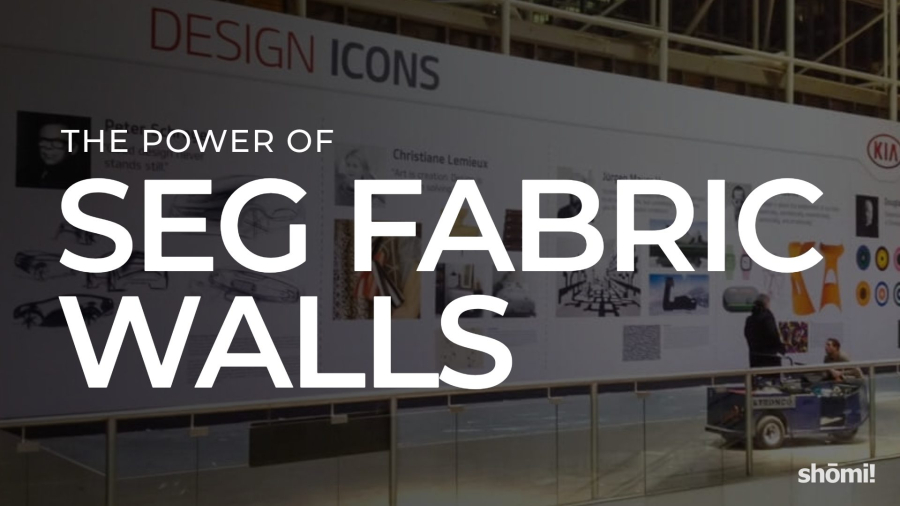
SEG fabric walls have quietly become one of the most-used display systems in retail, trade shows, and corporate environments, and most of the people standing in front of them have no idea what they’re looking at. They just notice the graphic is huge, the edges are perfectly clean, and there’s no visible frame.
Here’s what the system actually is, why it’s become the default for large-format display work, and where it earns its place.
What SEG actually is
SEG stands for Silicone Edge Graphics. The system is straightforward once you’ve seen it once: a printed fabric graphic has a thin silicone bead sewn into its perimeter, and that bead pushes into a channel that runs around the inside of an aluminum frame. When the fabric tensions into the channel, it pulls completely flat and disappears the edge. No visible frame edge, no wrinkles, no exposed hardware. Just a clean, taut, frameless-looking graphic.
The aluminum frame stays. The fabric graphic swaps out. That single fact is most of why the system has taken over the industry.
Why it’s become the default for large-format display
Graphics swap, frame stays
A traditional rigid printed panel is a one-time-use object. When the campaign changes, the panel gets replaced and the old one heads to a dumpster. With SEG, the frame stays in place across years and campaigns. You ship a folded piece of fabric instead of a 4-by-8-foot rigid panel. The freight savings alone justify the system on most repeat-campaign builds, and the environmental case is a real one.
The visual quality is hard to beat
The dye-sublimated print on a properly tensioned fabric reads as a single continuous surface. In most cases, large-format fabric can be printed in one piece at sizes that would require seaming multiple rigid panels together, which means no visible joins breaking up the graphic. Compared to a rigid panel with visible edges and seams, or a vinyl banner with corner grommets, an SEG wall reads as more deliberate, more designed, and more premium. It’s the closest a large-format display gets to looking like it was always part of the architecture.
It scales
SEG works at almost any size: a 2-foot accent panel, a 30-foot trade show backwall, a curved feature wall in a retail space, a suspended fabric structure over a corporate lobby. The aluminum frame system is modular, which means a single graphic library can be assembled in different configurations as a space or campaign demands.
Installation is faster than the system has any right to be
This is the part most people don’t believe until they’ve watched it happen. A correctly designed SEG wall goes up in a fraction of the time a rigid panel installation takes. The frame snaps together, the fabric pushes in around the perimeter, and the wall is finished. When we helped Canadian Tire transform a hotel conference room into a fully branded space for their 100th anniversary, the entire build happened overnight. Try that with rigid panels.
Where SEG earns its place
The systems are versatile, but they shine brightest in a few specific applications:
- Trade show backwalls and exhibits. Light to ship, fast to install, dramatic at scale, and the graphic refreshes each show without rebuilding the frame.
- Immersive retail environments. Curved walls, themed spaces, and full-room takeovers that require the graphic to read seamlessly across large surfaces. Arcadia Earth is one example we worked on: large-scale fabric installations were a core part of the immersive build.
- Backlit displays. SEG fabric over an internal LED array produces a frameless lightbox with even illumination across the full surface. Useful anywhere ambient light is low, or where the display needs to compete visually with brighter surroundings like windows, screens, or other backlit signage.
- Corporate lobbies and office environments. Branded fabric panels create a permanent-looking architectural feature that can still be updated when the brand evolves.
- Pop-ups and short-run activations. A pop-up that needs to look brand-new in a different city next month is exactly the case SEG was designed for.
A few honest caveats
SEG isn’t always the right call. The frame system has a real upfront cost, which doesn’t pay back on a one-time build that’s never being reused. Very small graphics (under a couple of feet) often look better in rigid materials. Outdoor installations need specific fabric and frame specs, since standard indoor SEG isn’t built for wind and weather.
Fabric choice also matters more than most people realize. Backlit, dye-sublimated stretch and non-stretch, black-back fabric for blocking light bleed-through, UV-printed non-stretch: each has a use case, and using the wrong one for the application is a common source of disappointing results. Stretch fabric on a tight curve, non-stretch on a flat panel, backlit on anything that needs to be lit from behind: the match-ups aren’t interchangeable.
The general rule: SEG is the right call when the graphic is going to change, when the install needs to be clean and fast, when scale matters, or when the space has design ambitions beyond a printed sign. It’s not the right call when none of those are true.
How shōmi! works with SEG
SEG is the underlying technology behind several of our product lines. FABRiK Frames are the unlit version: wall-mounted, suspended, free-standing, and custom configurations for retail, trade shows, corporate, and experiential builds. iMPAKT Lightboxes are the backlit version, using the same SEG fabric system over an internal LED light array for displays that need to read in low light or compete with bright surrounding environments. iMPAKT in-motion takes the lightbox further with programmable LED sequencing, so the graphic itself can animate and shift while the fabric stays static.
We work across the full fabric range (dye-sublimated stretch and non-stretch, backlit, non-lit black-back, UV-printed non-stretch), so the fabric gets matched to what the build actually needs, rather than what’s easiest to source.
If you’re considering SEG for an upcoming project and want a second opinion on whether the system fits, or how to spec it for what you’re trying to do, we’re happy to take a look.


